
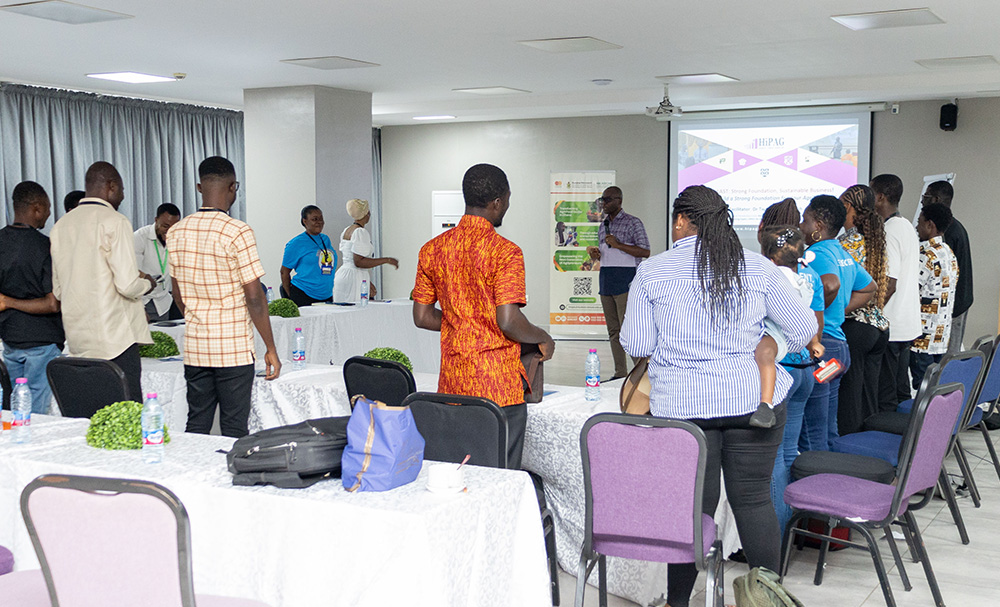
The KNUST Nutrition and Sustainable Agri-food Collaborative, in partnership with the Mastercard Foundation (Nkabom Collaborative) has launched a three-day intensive management and regulatory training programme for 16 small-scale agri-food enterprises that recently secured grant funding.
The training forms part of the Collaborative’s post-award support initiative aimed at strengthening managerial capacity and deepening regulatory compliance to ensure the long-term sustainability of the beneficiary enterprises.

Speaking at the opening ceremony, Project Manager Dr. Charlotte Adjanor-Doku said the programme was designed to equip the grant awardees with practical business management skills and a stronger understanding of Ghana’s regulatory environment.
“We decided to organise this programme specifically to train them on business management and some regulatory requirements they need to know, especially in establishing businesses in Ghana,” she stated.
She said the training covers key areas including revenue generation, tax obligations as prescribed by the Ghana Revenue Authority, environmental compliance requirements outlined by the Environmental Protection Agency, and the protection of intellectual property.

Facilitator Dr. Isaac Tweneboah-Koduah said that although the awardees had demonstrated innovation and secured funding, the greater challenge lies in deploying the funds effectively to build profitable and scalable enterprises.
According to him, participants are being guided to revisit and refine their vision and mission statements, reassess their business models and align their strategies with their new financial position.
“The business model based on which they got the idea will be totally different now that they have the money. They have to go back and look at their strategy and see whether it is still fit for purpose,” he noted.
Dr. Tweneboah-Koduah underscored the importance of team leadership and organisational structure, observing that many start-ups fail not because of weak ideas but due to poor coordination and financial mismanagement.
“Most businesses fail because of poor management of their money. They are unable to separate their personal monies from the business money. They mix everything together and eventually struggle,” he stated.
He added that the training would help entrepreneurs to structure their teams effectively, define roles clearly and manage finances responsibly to ensure sustainability and growth.
Another facilitator, Dr. Nana Baah Pepra-Ameyaw, focused on promoting food hygiene and sanitation standards among the enterprises.
“Our goal is to turn these entrepreneurs from reactive entrepreneurs to proactive entrepreneurs who do not wait for problems to happen before they fix them,” he said.
He stressed the need for businesses to embed food safety into their operations to prevent hygiene challenges.
“I am very optimistic about the potential of this cohort. They are promising entrepreneurs with bright futures in Ghana’s agri-food sector,” he stated.


